
When the Color Band Narrows
Cascade Volumes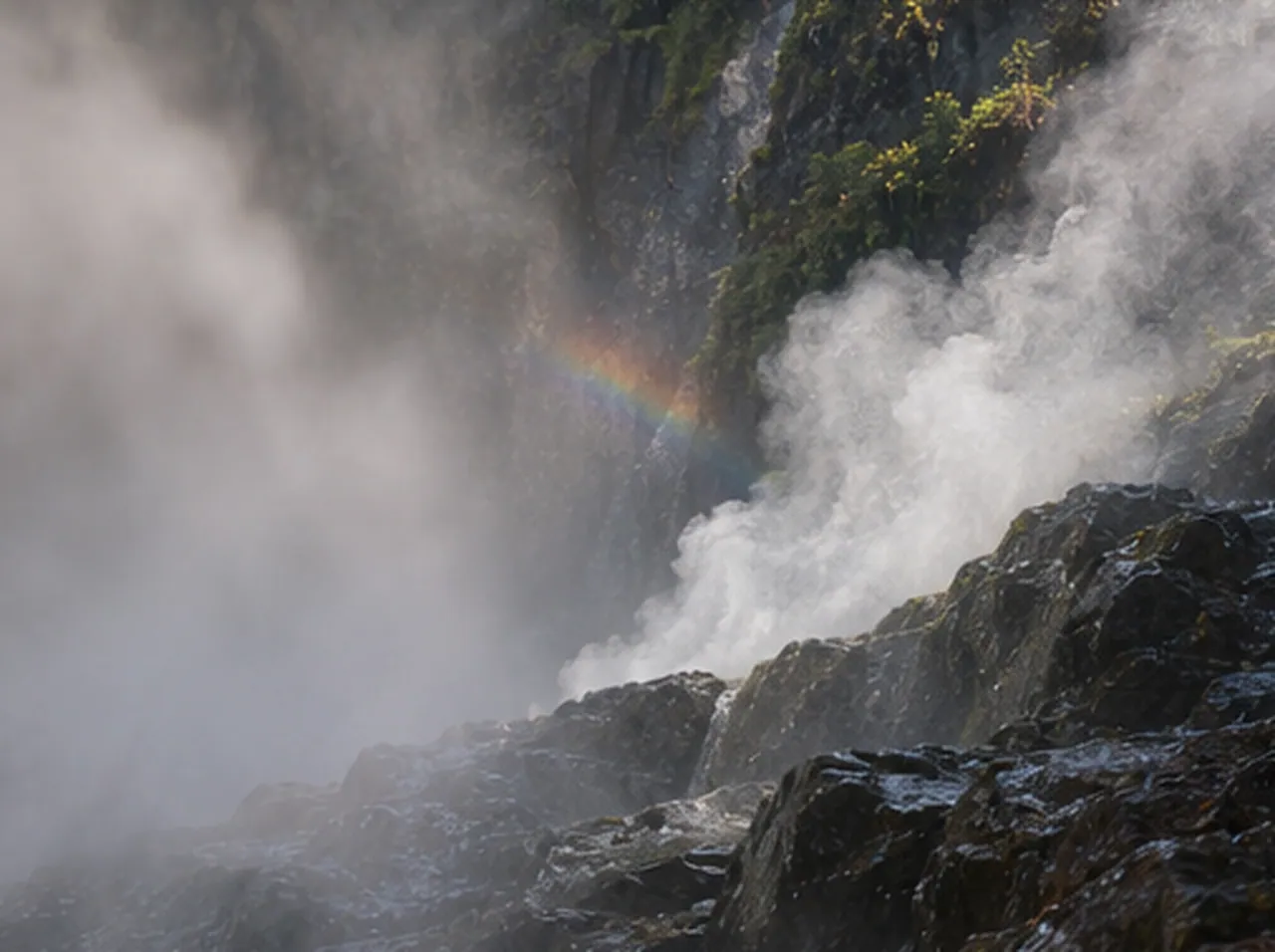
Locate the first firm end
A broad rainbow takes up much of the open mist at the start of the study. The bank closest to the scout is shaded, so one end forms a sharp orange and green edge against dark rock. The far end crosses a bright veil and becomes harder to distinguish. As the front of the mist moves, the opening shrinks in toward that far edge. A short section remains attached to the original place on the wall.
Keep the close wall under the same light
The early version of the image brightened the whole bank when the sun reached the mist. The colored end vanished as the new brightness rose behind it. We kept the rock darker directly below the narrow band and moved the light patch higher. The wall stays deep enough in shade to show a little color when both curtains almost meet. That gives the player an endpoint to compare with the earlier, much longer band.
Change the width from two directions
The near curtain crosses from the right. The far cloud narrows the opening from above. They do not create a simple shrinking rectangle of sky. The part of the band that survives becomes thinner as the front curtain crosses its face, then grows a little again before slipping behind the top cloud. The Weight of the Spray explains why the two layers need their own edges. A clear picture of the clouds makes a brief recovery of color possible to see.
Try a slow adjustment against the gap
A Rainbow Held Open gives control over a mirror low on the bank. The reflection can reach another portion of the back curtain from that position. Point it toward the original end and see how long the color remains recognizable through the movement. Turning toward the bright side can move the color away from the dark background. This gives the player a reason to check the position of both ends before choosing what to preserve in the next cycle.
Leave one color neutral
Changing the volume of the spray also changes the visible color. A very dense white foreground can turn the light toward pale blue, especially when only a short section survives. We avoid assigning one color to the correct amount of mist. The main clue is the changing width and its relation to the nearby dark wall. When color is hard to distinguish, the thin section still has a shape that can be followed through the gap.
Use the fern as a smaller comparison
At the low end of the bank a fern drops across the edge of the open spray. Its curved outline becomes visible again before the far band is wide. The fern gives you a second kind of information about the movement. It shows that the nearest curtain has started to pass. The player can hold the mirror in place until the farther part of the section returns. That pause often produces a longer connected shape than another quick adjustment.
Review an unsuccessful finish from the overlook
A person can end the test while the surviving patch is behind the brighter layer. The result view takes them back to the same wide picture used at the beginning. Keep the dark wall in view so the player can say where they last saw a clear bit of the band. It is worth preserving the earlier clue even when the new view contains almost no visible color. The next adjustment can begin near that known place.
Record the shorter view
Cascade Volumes keeps the bright early image and the narrowed image together. The change only makes sense when the wall is in both pictures. On a new scene we should check a narrower ledge with a feature visible above the mist. The band can then shift down during the watch without losing the only reliable edge on which the comparison rests.